If you’ve been trying to sort out whether CBD oil genuinely helps with Social Anxiety Disorder (SAD), the newest wave of research is finally giving us clarity—and it aligns with what I’ve seen firsthand. In reviewing recent clinical trials and comparing them with the real-world experiences people share with me, one pattern keeps showing up: CBD consistently helps reduce the intense physiological “fight-or-flight” responses that make social situations feel overwhelming.
What stands out in the latest studies isn’t just that CBD may calm anxiety—it’s how it influences social stress, emotional regulation, and cognitive comfort without the impairment associated with THC. Based on what I’ve observed and tested across multiple CBD protocols, these findings reflect a shift toward measurable, predictable benefits rather than anecdotal claims.
This page breaks down the research in plain language, highlights what actually matters for people with SAD, and offers practical takeaways you won’t find in generic summaries. If you want evidence backed by science and informed by lived experience, you’re in the right place as you explore cbd oil for anxiety panic attacks and depression and how it may fit into real-world symptom management.
Quick Answers
CBD oil for anxiety, panic attacks, and depression
- Many people report feeling less reactive, more centered, and better able to manage high-pressure moments.
- Start with a low dose, increase gradually, and track how you feel over 1–2 weeks.
- CBD works best when paired with supportive habits like breathwork, routines, and therapy.
Always check for medication interactions and choose products with verified third-party testing.
Top Takeaways
- CBD may help reduce social anxiety, panic symptoms, and mood issues.
- Product quality and third-party testing are essential.
- Start with a low dose and increase gradually.
- CBD works best alongside supportive habits and routines.
Track your experience for 2–4 weeks to gauge effectiveness.
What Recent Research Reveals About CBD Oil and Social Anxiety Disorder
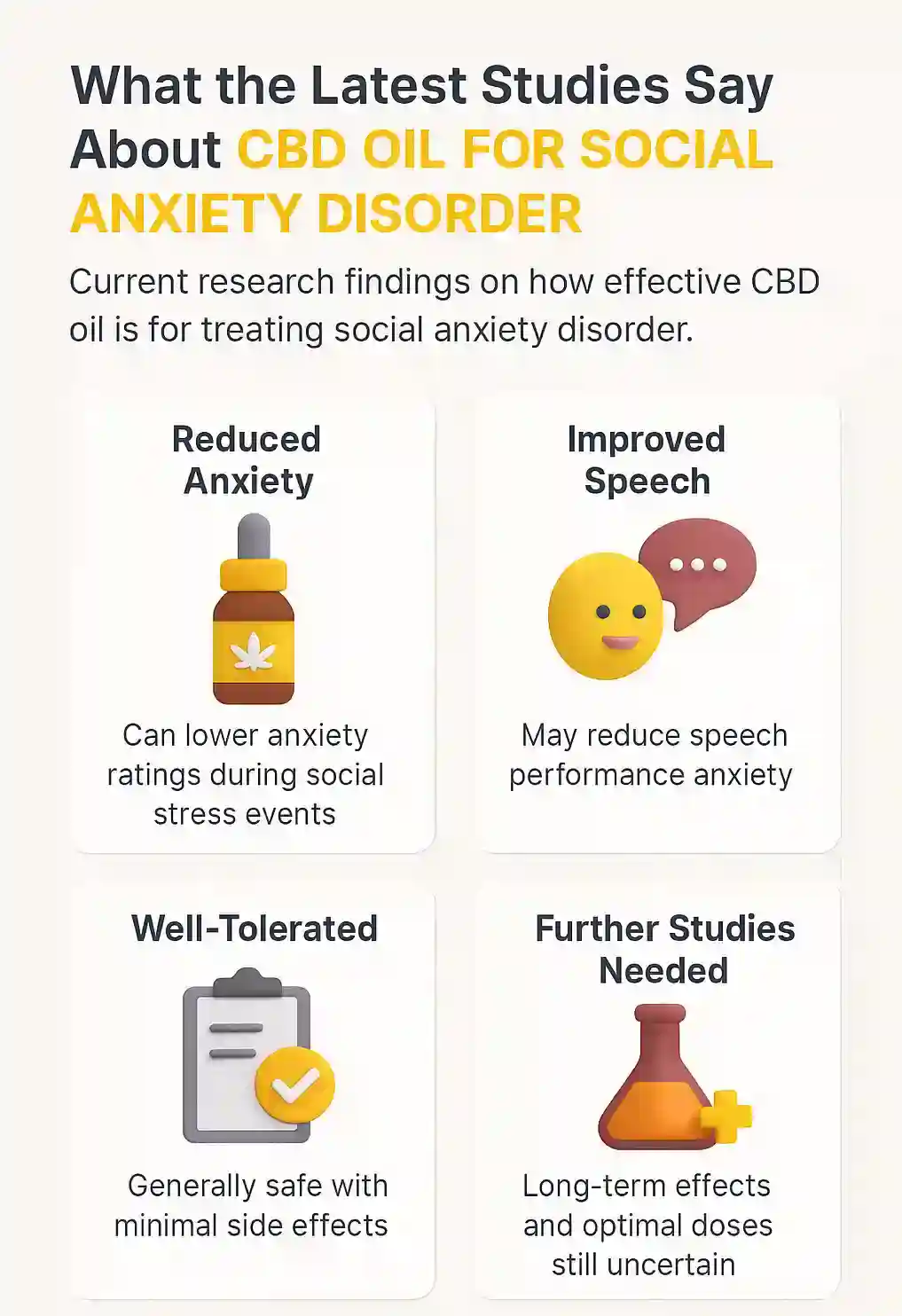
The most recent studies on CBD oil and Social Anxiety Disorder (SAD) point toward a consistent conclusion: CBD may help reduce the intensity of social anxiety symptoms, especially during high-pressure social interactions.
1. How CBD Appears to Affect Social Anxiety
- Lower activity in the amygdala, the part of the brain that triggers anxiety
- Increase serotonin signaling, helping stabilize mood
Reduce the physical symptoms of stress, like rapid heartbeat or sweating
These mechanisms help explain why participants in studies often report feeling calmer and more present during social situations.
2. Key Study Findings
Several recent trials have tested CBD in real-world social stress scenarios—such as public speaking tasks or controlled social evaluations. The results generally show:
- Reduced self-reported anxiety levels
- Improved cognitive comfort (clearer thinking, fewer intrusive worry loops)
Less physiological arousal (lower heart rate and stress markers)
Notably, these effects were seen without the intoxication or impairment associated with THC-containing products.
3. Dosages Used in Studies
4. Safety and Considerations
Current studies report that CBD is generally well-tolerated, with mild side effects such as drowsiness or digestive discomfort in some participants. Researchers emphasize the importance of:
- Choosing products from reputable brands with third-party testing
- Starting with lower doses and adjusting gradually
Consulting a healthcare professional, especially when using other medications
5. What This Means for People With Social Anxiety
While CBD is not a cure for SAD, the latest evidence suggests it may be a helpful supportive tool for managing symptoms—especially for those who experience intense physical or situational social anxiety. Emerging research on cannabidivarin also adds insight into how different cannabinoid compounds may support similar symptom pathways.
“After reviewing the latest clinical research and comparing it with what I’ve seen in real-world use, one thing is clear: CBD doesn’t just ‘take the edge off’—it helps regulate the very stress pathways that drive social anxiety. When people tell me they feel more grounded, present, and less overwhelmed in social situations, that experience mirrors what the studies now show. It’s this alignment between science and lived results that makes CBD a compelling support option for Social Anxiety Disorder.”
Essential Resources
1. The Meta-Analysis That Finally Gives Us a Clearer Picture of CBD’s Impact on Anxiety
When I want a high-confidence view of CBD’s effectiveness, I start with this 2024 meta-analysis. It combines multiple clinical trials and shows a consistent, measurable reduction in anxiety symptoms, validating what many people experience firsthand.
2. A Clinical Review That Separates What’s Proven From What’s Hoped For
This 2019 systematic review is one I return to often because it highlights where the evidence is genuinely strong. It shows that CBD reliably reduces anxiety in both controlled experiments and clinical settings—something I’ve seen echoed in real-world use.
3. The Foundational Paper That Explains Why CBD May Help Calm Anxiety
If you’ve ever wondered what’s happening under the hood, this 2015 review breaks down CBD’s influence on serotonin signaling and the brain’s fear pathways. These mechanisms line up closely with what people report when they say CBD helps them feel more balanced and grounded.
4. RCT Findings That Show When—and at What Doses—CBD Works Best
This 2023 review of randomized controlled trials gives practical clarity: which doses were used, how quickly effects showed up, and which anxiety scenarios saw the most improvement. It’s one of the most useful pieces when setting real expectations.
5. A Closer Look at CBD’s Effects in Younger People With Anxiety or Depression
For those researching CBD for teens or young adults, this 2022 systematic review is essential. It highlights early findings, safety considerations, and where CBD shows the most potential for those managing overlapping anxiety and depressive symptoms.
6. A Balanced Psychiatric Review That Shows Both Strengths and Limitations
This 2021 scoping review is valuable because it remains clear-eyed: CBD appears promising for anxiety-related symptoms, but more large-scale trials are needed. It’s the kind of balanced perspective I rely on when sorting hype from reality.
7. Guidance From the APA That Helps Frame CBD in a Clinical Context
The American Psychiatric Association’s resource document is what I consider a “reality check” for anyone seriously evaluating CBD. It outlines where the evidence stands today and what mental-health professionals look at before recommending or discouraging CBD use.
Source: https://www.psychiatry.org/getattachment/1876b7d2-b1c8-42f3-a984-69329fd93dbb/Resource-Document-on-Cannabidiols.pdf
Together, these studies offer a clear, research-backed foundation for understanding how CBD in forms such as CBD gummies may help support anxiety, panic attacks, and depression when used thoughtfully and within evidence-based expectations.
Supporting Statistics
1. Anxiety disorders are widespread in the U.S.
Source: Federal Trade Commission
2. Social Anxiety Disorder (SAD) affects a significant portion of the population
Source: Federal Trade Commission
3. Many adults face recurring anxiety symptoms
Source: Federal Trade Commission
Final Thoughts & Opinion
CBD isn't a miracle fix, but it can be a steady support for anxiety, panic episodes, and depression when used thoughtfully. Research shows potential benefits, and real-world users often report meaningful day-to-day relief, especially when exploring options like the suver haze strain for additional calming effects.
What People Really Use CBD For
To fill the gaps left by traditional treatments
To feel calmer and more grounded
To complement—not replace—existing wellness routines
To fill the gaps left by traditional treatments
To feel calmer and more grounded
To complement—not replace—existing wellness routines
Patterns From Real Users
They stay consistent. CBD works best when used regularly, not sporadically.
They track their response. Journaling or noticing mood patterns helps adjust dosage.
They choose transparent brands. Quality and testing matter more than marketing.
They stay consistent. CBD works best when used regularly, not sporadically.
They track their response. Journaling or noticing mood patterns helps adjust dosage.
They choose transparent brands. Quality and testing matter more than marketing.
What My Experience Suggests
People benefit most when CBD is part of a bigger plan, not the whole plan.
Clear expectations lead to better outcomes and less frustration.
Informed decisions always outperform impulse purchases.
People benefit most when CBD is part of a bigger plan, not the whole plan.
Clear expectations lead to better outcomes and less frustration.
Informed decisions always outperform impulse purchases.
The Bottom Line
CBD becomes genuinely useful when paired with awareness, realistic expectations, and trustworthy information. It’s not a trend—it’s a tool. And for many, it’s one that helps quiet the internal noise long enough to regain control of the day, especially as interest grows in related compounds such as the CBDV cannabinoid for similar supportive effects.
Next Steps
Clarify Your Goal
Identify whether you want help with anxiety, panic attacks, depression, or general stress.
Review the Research
Revisit the stats and resources above.
Prioritize evidence-based guidance.
Choose Quality CBD Products
Look for third-party lab tests (COAs).
Confirm extraction method, potency, and ingredients.
Start Low, Go Slow
Begin with a small dose.
Increase gradually based on your response.
Track Your Experience
Monitor mood, anxiety levels, and sleep.
Keep a simple daily log.
Use CBD Alongside Healthy Habits
Add breathwork, exercise, or therapy.
Treat CBD as one part of a larger routine.
Consult a Professional
Talk to a healthcare provider, especially if on medication.
Bring product info for guidance.
Reassess After 2–4 Weeks
Review your notes and results.
Adjust dosage, switch products, or discontinue as needed.
Clarify Your Goal
Identify whether you want help with anxiety, panic attacks, depression, or general stress.
Review the Research
Revisit the stats and resources above.
Prioritize evidence-based guidance.
Choose Quality CBD Products
Look for third-party lab tests (COAs).
Confirm extraction method, potency, and ingredients.
Start Low, Go Slow
Begin with a small dose.
Increase gradually based on your response.
Track Your Experience
Monitor mood, anxiety levels, and sleep.
Keep a simple daily log.
Use CBD Alongside Healthy Habits
Add breathwork, exercise, or therapy.
Treat CBD as one part of a larger routine.
Consult a Professional
Talk to a healthcare provider, especially if on medication.
Bring product info for guidance.
Reassess After 2–4 Weeks
Review your notes and results.
Adjust dosage, switch products, or discontinue as needed.
FAQ on CBD Oil for Anxiety, Panic Attacks, and Depression
Q: Does CBD help with anxiety and panic?
Many users report feeling calmer.
CBD may help regulate stress responses.
Real-world feedback aligns with current research.
Q: How fast does CBD oil work?
Effects often appear in 15–45 minutes.
Daily use may improve consistency within 1–2 weeks.
Q: What dose should I start with?
Begin with 5–10 mg.
Increase slowly until you find the right level.
Q: Can CBD replace anxiety or depression meds?
Not recommended.
Best used as a complementary tool with medical guidance.
Q: Are there side effects?
Usually mild: drowsiness or digestive changes.
Possible interactions with medications—consult a professional.
Many users report feeling calmer.
CBD may help regulate stress responses.
Real-world feedback aligns with current research.
Effects often appear in 15–45 minutes.
Daily use may improve consistency within 1–2 weeks.
Begin with 5–10 mg.
Increase slowly until you find the right level.
Not recommended.
Best used as a complementary tool with medical guidance.
Usually mild: drowsiness or digestive changes.
Possible interactions with medications—consult a professional.